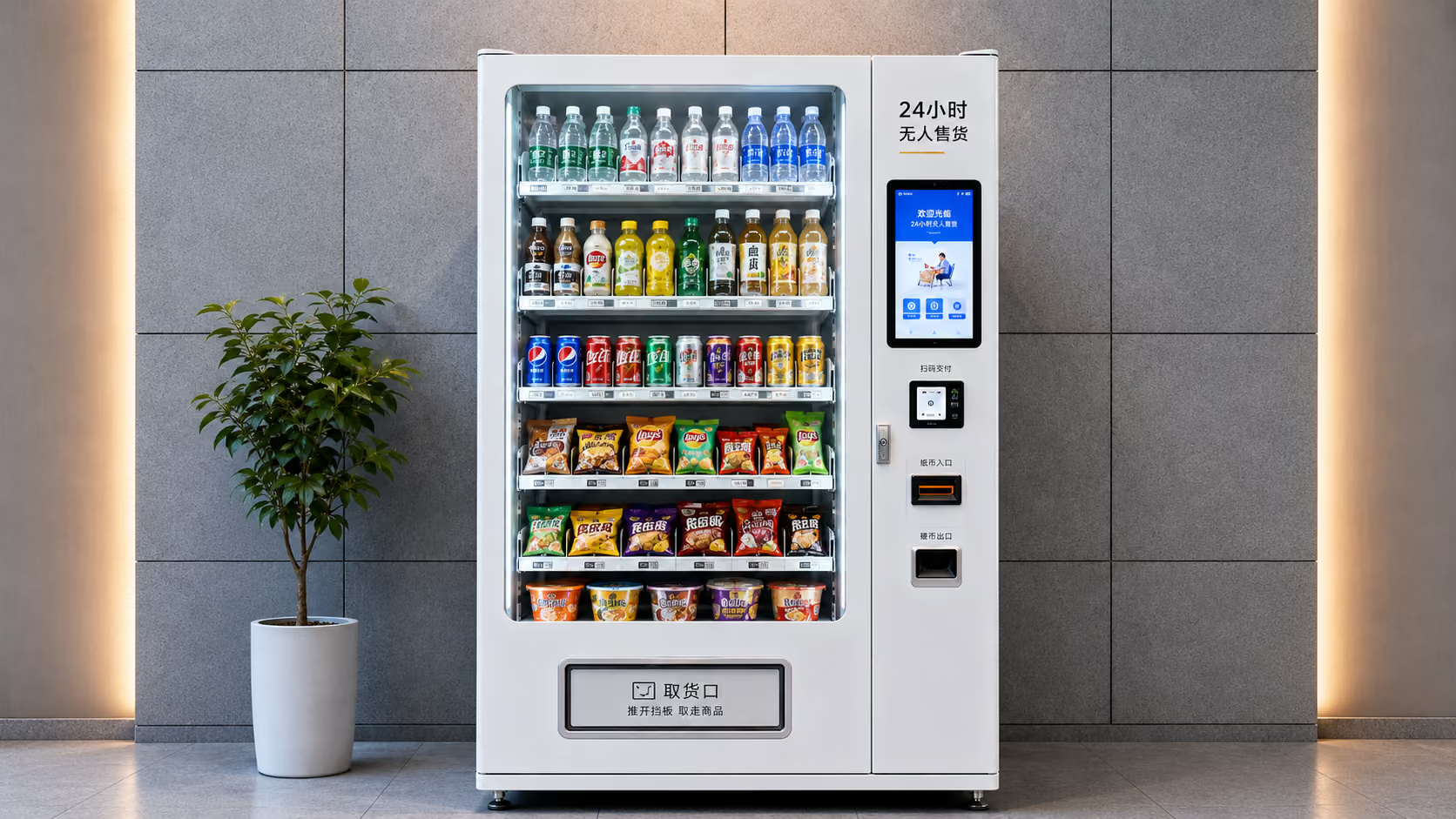
The control board is the heart of a vending machine. It determines whether lanes vend reliably, whether faults are caught in time, and whether the cabinet can scale cost-effectively later. Poor selection usually only surfaces after volume deployment.
Bottom line: match driver channels to your lane structure and motor types first, then choose the detection method for your delivery mechanism, and finally pick the communication scheme for cabinet scale and how you operate — the right model follows from these three decisions.
Here is a four-step selection checklist, a model comparison table, and the common mistakes to avoid.
Step 1: Count your lanes and actuators
Lane count dictates the number of motor driver channels you need. The AHD-15 drives 15 vending lanes, the ATG-4 handles 4 actuator/DC-motor channels, and the AXY-2 coordinates X-Y stepper axes. Count your motor types (stepper, DC, pusher) and channels first, then match the board — avoid the trap of “not enough channels, forced to cascade extra boards”.
Step 2: Delivery detection is non-negotiable
Motor rotation alone does not equal a successful vend. Boards with optical sensor inputs (AXY-2 supports up to 17 channels) verify whether the product actually dropped, then reverse briefly to prevent motor jams. For spring and belt lanes that tend to jam, detection capability directly determines after-sales cost.
Step 3: Leave headroom for communication and cascading
Cabinets with dozens of lanes almost always need multiple boards. Choose boards with RS485 daisy-chaining (AHD-15, AXY-2) to scale channel counts via bus addresses; for remote management, prefer models with built-in 4G (WHD-100) so sales data goes straight to the cloud.
Step 4: Power and environment
Most boards accept DC 12V–24V and operate from -20°C to +70°C. For outdoor cabinets, review environmental tolerance and protection; size the power supply with margin for peak current.
Model comparison
| Model | Control capability | Detection | Communication | Best for |
|---|---|---|---|---|
| AHD-15 | 15 independent vending lane motors | Current sensing / optical sensors | RS485 × 1, TTL × 1 | Spring and belt cabinets with many lanes |
| ATG-4 | 4 independent pusher channels (hydraulic pusher / DC / stepper) | — | TTL × 1, RS485 × 1 | Pusher and lift mechanisms |
| AXY-2 | 2 stepper axes + 8 reversible DC channels | 17 optical sensor inputs | RS485 × 1, TTL × 1 | X-Y coordination, high detection precision |
| WHD-100 | 100 matrix-driven vending lanes | Current + optical sensing | 4G LTE Cat.1 / TTL | Large cabinets, remote management first |
All four models accept DC 12V–24V. Full specifications are on each product page.
Common mistakes
Mistake 1: More channels is always safer. Extra channels mean higher board cost and more complex wiring. Size for your actual lane count plus one year of planned growth, not the biggest board available.
Mistake 2: Focusing on motors, ignoring locks and auxiliary mechanisms. Cabinets with solenoid locks, door locks or pushers need matching drive capability and detection logic. The right motor channels with the wrong actuator support still means an unstable cabinet.
Mistake 3: Treating communication headroom as waste. Retro-fitting remote management or multi-board coordination after deployment costs far more than choosing the capability up front. Keep RS485/4G options in the spec and later expansion is a configuration change, not a board swap.
FAQ
Q: What if lane count exceeds a single board’s driver channels? A: Cascade multiple boards over RS485 and scale via bus addresses — models like AHD-15 and AXY-2 support daisy-chaining, covering cabinets with dozens or even hundreds of lanes.
Q: What is the operating temperature range of vending control boards? A: Mainstream models operate from -20°C to +70°C with DC 12V–24V input. Outdoor deployments should also evaluate protection rating and power supply margin.
Q: Not sure which model fits? A: Send your cabinet structure, motor types and channel counts, and detection requirements to Xinyun IoT — our engineers will recommend a specific model and verify interface compatibility before you commit.
Choose the right board and your vending machine gains stability and headroom to grow. Not sure where to start? Send us your cabinet structure — our engineers will recommend a specific model.
Related products and specifications
Use the published model pages below to verify channel counts, communication interfaces, detection capabilities and target applications.